


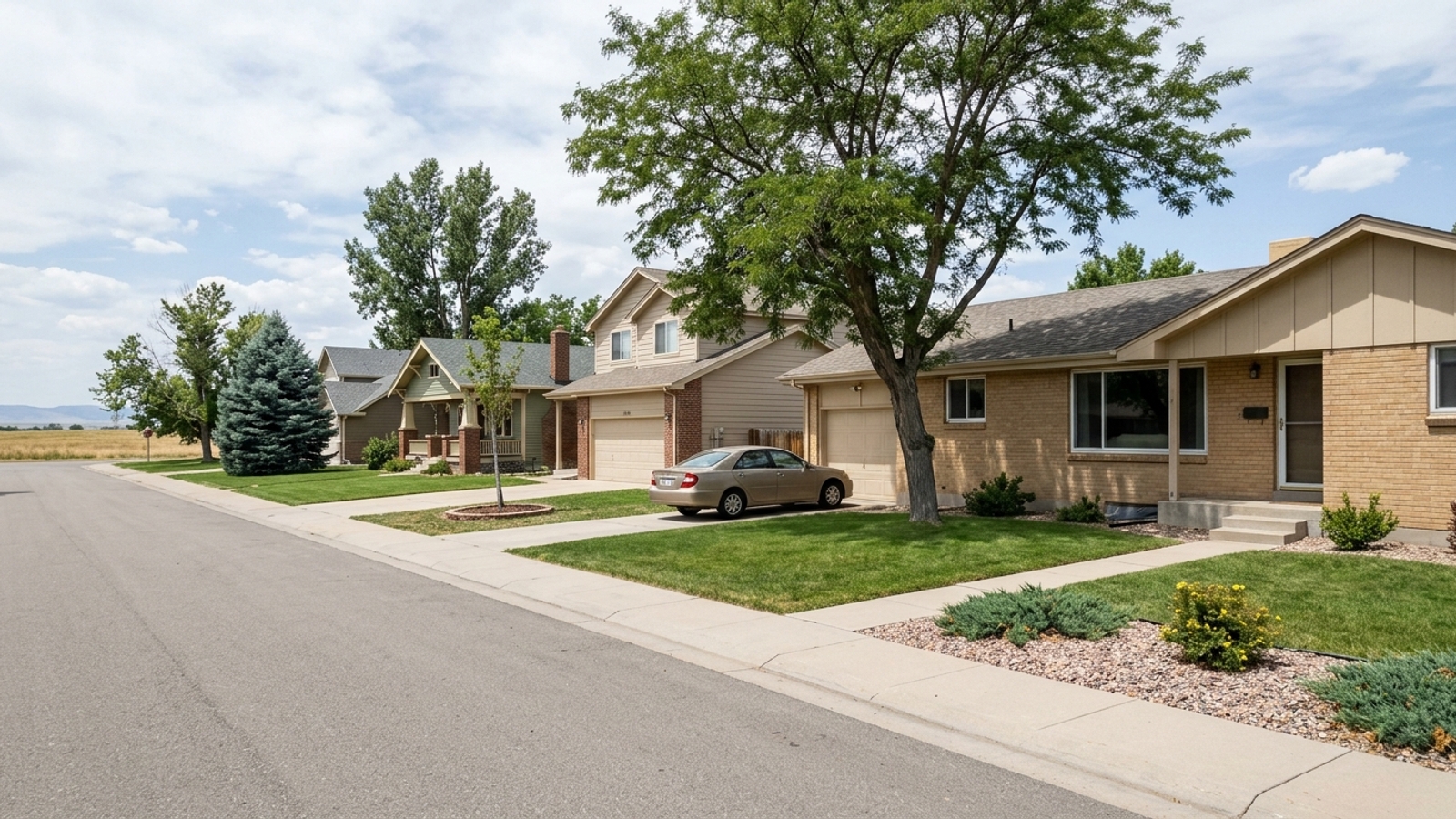
Selling a house means telling the buyer what you know about the property's condition and history. In Colorado, that obligation comes from specific statutory warnings and the common-law duty to reveal hidden defects.
For a home sale in Greeley, CO, local factors add specific requirements to that list. Sellers often need to pull property tax records to identify metro district levies, or check title commitments to see if they own the mineral rights under their lot.
Key takeaway
Before you list, fill out Colorado's Seller's Property Disclosure completely and add the items Greeley sellers most often miss: water source, metro district taxes, and mineral rights. In a market where fewer than one in five homes sells above list, buyers have the time and negotiating power to renegotiate over anything they find late, so early disclosure protects your price. If you are selling without a full-service broker, get the Commission's current form and have a Colorado real estate attorney review it before it goes to a buyer.
Who this guide is for
You are getting ready to list a Greeley home and need to know which disclosures you owe, what paperwork to gather, and when each item is due in the contract.
How seller disclosures affect a Greeley sale
In the 90 days ending September 30, 2026, the median Greeley home took 61 days to sell, with 4.6 months of supply on the market. That is enough time for buyers to read the disclosure carefully, inspect the house, and use the objection deadline to push back on anything that was not disclosed up front. They are not rushing to waive inspections.
A complete, early Colorado Seller's Property Disclosure that also covers the Weld County items protects your price better than a thin document that leaves surprises for the inspection objection. Buyers who already know the property's flaws before they write the contract keep their offers close to asking. You can check current market trends to see how these timelines fit into broader pricing, and you should consult a Colorado real estate attorney for specific legal situations.
What is the Colorado Seller's Property Disclosure?
The current Colorado Real Estate Commission Seller's Property Disclosure (Residential) form is SPD19, a 14-page document with a mandatory use date of January 1, 2026. It asks you to detail the property's structure, roof, systems, water supply, environmental conditions, HOA details, and legal or title issues based on what you know. You fill it out yourself. Answering "Unknown" is appropriate only when you genuinely do not know the answer.
The standard Colorado contract sets a binding deadline for delivering this form. Section 10.1 of the Commission-approved Contract to Buy and Sell Real Estate (Residential) requires you to provide the completed form on or before the Seller's Property Disclosure Deadline specified in the contract. Confirm you are using the current version with your broker or on the Colorado Real Estate Commission's site before you start filling it out.
Which disclosures apply to your home
The federal government, the state of Colorado, and Weld County all impose different disclosure rules on a home sale. If your home was built before 1978, the federal lead-based paint disclosure applies, and the section below covers that. If your home is in an HOA, or in a newer subdivision whose tax bill shows a metro district levy, read about HOA documents and special taxing districts first.
Condo sellers should order association documents before listing. You also need to find out whether you own the mineral rights under your lot and whether there is oil and gas activity nearby. If you are unsure, start with the oil, gas, and mineral rights section. And if you are selling FSBO or through a flat-fee MLS listing, read about who handles disclosures when there is no full-service agent in the picture.
Disclosures Colorado requires on every sale
Colorado statutes and common law establish a baseline of property information that every seller must provide. These requirements apply whether you are selling a downtown Greeley Victorian or a new build on the edge of town, covering everything from the physical condition of the property to specific taxes and environmental hazards tied to the lot.
Gathering your documents before you list gives you time to verify facts rather than guess on the form. That matters in a slower market where buyers have every incentive to push back on undisclosed issues.
Known latent defects
Colorado common law requires sellers to disclose known latent defects, a rule traced to the 1960 case Cohen v. Vivian. You must reveal any material defect you know about that a buyer could not reasonably spot during a standard walk-through: past basement water intrusion, a prior foundation repair, a roof leak that was patched.
If you have had foundation or drainage work done, you need to say so. Gather your repair invoices, permits, warranties, and past inspection reports before you fill out the form. These documents show what you knew and when, which helps you answer accurately.
Claiming ignorance only protects you if it is true. A contractor's invoice in your own records showing you paid to fix a problem undercuts that defense entirely.
Lead-based paint in homes built before 1978
Under federal law, sellers of homes built before 1978 must disclose any known lead-based paint or hazards to the buyer. You must provide any available records, give the buyer an EPA lead hazard information pamphlet, and attach the required warning language to the contract. You can check the ages and styles of Greeley homes to see how common this era of construction is locally.
Buyers of pre-1978 homes are entitled to a 10-day opportunity to test for lead before they become bound by the contract, so this disclosure adds time to the deal. Collect any past lead inspection or abatement reports you have on file. If the form is missing at signing, it cannot be fixed afterward.
Source of water
Colorado requires the seller to disclose the property's source of potable water in every residential transaction. Most in-town Greeley homes rely on municipal water, but properties on the edges of the city may use a private well. You can review city water vs well costs to see how this affects a household budget.
If your source is a well, you must provide a copy of the current well permit if it is available. Locate your well permit and any recent water test results before you list. If you are on a well and cannot produce the permit, the buyer's lender may require a water test or additional paperwork, which pushes your closing date.
Special taxing and metro districts
Every contract for the purchase and sale of residential real property in Colorado must contain a bold-faced disclosure warning that special taxing districts may carry general obligation debt paid through annual tax levies. Metro district levies appear on the property tax bill and can make the total tax burden higher than a buyer might estimate from the list price alone.
Check your Weld County property tax bill for metro district or special district line items and share it up front. A buyer who spots a metro district levy after their lender recalculates the monthly payment may renegotiate or walk. Showing your tax bill early heads that off.
Methamphetamine labs
A buyer of residential real property in Colorado has the right to test the property to determine whether it has ever been used as a methamphetamine laboratory. Under state law, you must disclose in writing if you know the property was previously used as a meth lab, except where specific remediation exceptions apply.
If a buyer's test shows contamination that has not been remediated to state health-board standards, the buyer may give written notice and terminate the contract. The seller then has 30 days to obtain a second independent test. If this applies to your property, you will need the cleanup documentation before you list.
Radon
Colorado law requires that each residential real estate sales contract contain a bold-faced disclosure stating that the state strongly recommends an indoor radon test before purchase. The sales contract or Seller's Property Disclosure must also state whether a radon test has been conducted, detail the most recent records, and note whether a radon mitigation system has been installed.
You must provide the buyer with any known radon test results and an electronic or paper copy of the current state radon information brochure. Find any past test results and mitigation system paperwork in your records before you list. A past high test result you never mitigated has to be shared, and mitigating before listing is usually simpler than negotiating over it after the buyer runs their own test.
Disclosures that depend on your property
Some disclosure requirements only trigger based on where your house sits or how the neighborhood is governed. Weld County properties frequently involve land-use and mineral-right variables that simply do not come up in other parts of the state, and they directly affect the buyer's ownership rights and monthly carrying costs.
Sellers often assume they own everything above and below their lot, or that their HOA fees are the only neighborhood obligation worth mentioning. Checking your title and association documents early keeps these property-specific details from derailing the transaction weeks into the contract.
Oil, gas, and mineral rights
Weld County has extensive oil and gas activity, and mineral rights are often owned separately from the surface estate. Colorado requires each contract of sale or seller's property disclosure to include information about mineral estate ownership and oil and gas activity, including noting that the surface estate's use to access minerals may be governed by a recorded surface use agreement.
Many Greeley owners do not own the minerals under their lot, and the title commitment, not the deed you remember signing, is what shows it. Read your title commitment for mineral reservations and look up nearby wells on the state's oil and gas map. If the buyer's title review finds a severance first, it reads like something you hid.
HOA and common interest community documents
Every contract for a home in a common interest community must contain a bold-faced disclosure stating that the property is subject to the community's declaration, and must warn the buyer that they will be a member of the owners' association, subject to its bylaws, financial obligations, and architectural review requirements.
Greeley condos took a median 100 days to sell, based on 23 condo sales in the 90 days ending September 30, 2026. A slow document request from an HOA management company stacks on an already long timeline. HOA management companies set their own turnaround times and document fees, so asking for current costs before you list prevents delays after you are under contract.
Floodplain and drainage
If your home sits in a mapped flood zone or has had water issues, that belongs on the disclosure and affects the buyer's insurance costs. You can review flood risk and safety data to understand how this affects the property, and look up your address on the FEMA flood map to confirm your zone. A lender-required flood policy raises the buyer's monthly cost, and finding that out late can cost you the deal.
When disclosures are due in a Greeley sale
The standard Colorado contract dictates exactly when your property disclosure is due. Gathering your repair invoices, tax bills, and well permits while you prepare the listing means you have the facts ready when an offer comes in.
Once you accept an offer, Section 10.1 of the standard contract requires you to deliver the completed Seller's Property Disclosure form on or before the specific deadline written into the agreement. After delivery, the buyer has until the inspection objection deadline to review the property and the documents. If your home was built before 1978, the buyer also gets a 10-day window to test for lead-based paint before they are bound by the contract.
Association documents and title commitments have their own delivery deadlines, usually falling shortly after the contract is signed. Undisclosed issues that surface during this period routinely turn into requests for seller concessions. You can review the full selling process to see how these deadlines fit into the broader transaction.
Pros and cons of disclosing more than the minimum
Disclosing everything you know about your property builds buyer trust and reduces post-inspection surprises. In a market where buyers are not rushing to waive their contingencies, a detailed disclosure file signals that you are maintaining the home and have nothing to hide. A long disclosure can unsettle some buyers, though, and speculation about causes or ages creates its own risk. Disclose documented facts rather than guessing about the source of a crack or the remaining life of a system.
Consider how this plays out at the inspection objection deadline. The median sale price for a Greeley single-family home was $433,534 in the 90 days ending September 30, 2026. For illustration only: a 1% seller concession negotiated at that deadline costs about $4,335. A seller who discloses a repaired roof leak up front and provides the roofer's receipt sets the price with that history already baked in. A buyer who discovers fresh ceiling stains during the inspection will likely demand a concession or walk away entirely.
Who handles disclosures when you sell without a full-service agent
Selling a house by owner or through a flat-fee MLS listing means you take on the full responsibility for legal compliance and contract deadlines. Under Colorado law, a broker acting as a single agent must disclose any adverse material facts they know about the property's title and physical condition to a prospective buyer. When you sell without a full-service agent, no one else carries that duty or tracks your contract deadlines.
A flat-fee MLS entry usually does not include a professional reviewing your forms. You own the form selection, completeness, and delivery schedule, which means you have to locate the correct Commission-approved documents and ensure they reach the buyer on time.
If you want an expert to handle the paperwork and deadlines, Jamie Eklund at P23 Realty can review a disclosure package before it goes to a buyer. You can connect with the best real estate agent in Greeley to keep your sale on track.
Greeley seller market at a glance
You can review the broader Greeley housing market to see how these figures affect your listing strategy.
- All homes median sale price: $423,158, down 2% year over year (308 sales, 90 days ending 2026-09-30)
- All homes median days on market: 61 (90 days ending 2026-09-30)
- All homes sale-to-list ratio: 99%; 17.5% sold above list (90 days ending 2026-09-30)
- All homes months of supply: 4.6, with 466 homes in inventory (90 days ending 2026-09-30)
- All homes median price per square foot: $180 (90 days ending 2026-09-30)
- Single family median sale price: $433,534, down 2.6% year over year; median 58 days on market; 19.8% sold above list (256 sales, 90 days ending 2026-09-30)
- Condo median sale price: $284,471, down 6.7% year over year; median 100 days on market; 4.3% sold above list (based on only 23 condo sales, 90 days ending 2026-09-30, so treat with caution)
- Townhouse median sale price: $370,004, up 7.2% year over year; median 76 days on market; 6 months of supply (based on only 17 townhouse sales, 90 days ending 2026-09-30, so treat with caution)
Greeley seller disclosure FAQs
Does Colorado require the SPD19 form specifically, or will any disclosure document do?
Yes, the SPD19 is the mandatory form. The Colorado Real Estate Commission sets the required version: the current SPD19 carries a mandatory use date of January 1, 2026, and using an outdated version can put you out of compliance with the standard contract's delivery requirement.
Can a buyer walk away if the seller's disclosure arrives late?
Yes. The standard contract sets a specific Seller's Property Disclosure Deadline. If the form is not delivered by that date, the buyer may have grounds to terminate the contract, so delivering the completed SPD19 on time is a contractual obligation, not a courtesy.
What's the purpose of the Green Disclosure form in Colorado?
The Green Disclosure (Energy) form is an optional Colorado Real Estate Commission-approved addendum. A seller uses it to disclose energy-efficiency features like ENERGY STAR appliances, solar elements, or high-efficiency HVAC systems for the buyer's information.
Is Colorado a non-disclosure state?
No. Colorado requires sellers to disclose known latent defects and specific statutory items, but sale prices are kept confidential from the public. When a deed is recorded, a Real Property Transfer Declaration (TD-1000) provides the sale price to the Weld County assessor, but this form is not recorded and is not available for public inspection.
Can I sell my Greeley house as-is and skip disclosures?
No. An as-is sale limits your obligation to make repairs, but it does not erase your common-law duty to disclose known latent defects or your statutory disclosure requirements. Consult a Colorado real estate attorney to understand your liability when selling a property as-is.
Do I have to disclose a death or crime in the home in Colorado?
No. Under Colorado's psychologically impacted property statute, facts that could stigmatize a property, such as a homicide, felony, or suicide, are not material facts requiring disclosure. If a buyer asks directly, however, Colorado law does not protect a seller who lies in response.
Where is the seller's disclosure on the MLS?
Disclosure documents are typically attached as listing documents visible to agents rather than shown on the public listing. Ask your listing broker or MLS provider how and where yours is attached and who can see it.
Sources
- Redfin: Data Center
- Colorado Division of Real Estate: Seller's Property Disclosure (Residential)
- PropCash: Colorado Seller Disclosure Requirements
- Colorado General Assembly: Title 38 Property - Real and Personal
- Colorado General Assembly: SB23-148 Illegal Drug Laboratory Property
- Colorado Division of Real Estate: Broker Practice Advisory SB23-206
- Electronic Code of Federal Regulations: 24 CFR Part 35
- Colorado Division of Real Estate: Contract to Buy and Sell Real Estate (Residential)
- Colorado General Assembly: Title 12 Professions and Occupations
- REcolorado: Green Disclosure (Energy)
- Weld County: Real Property Transfer Declaration
- Colorado Office of Legislative Legal Services: CRS Title 38